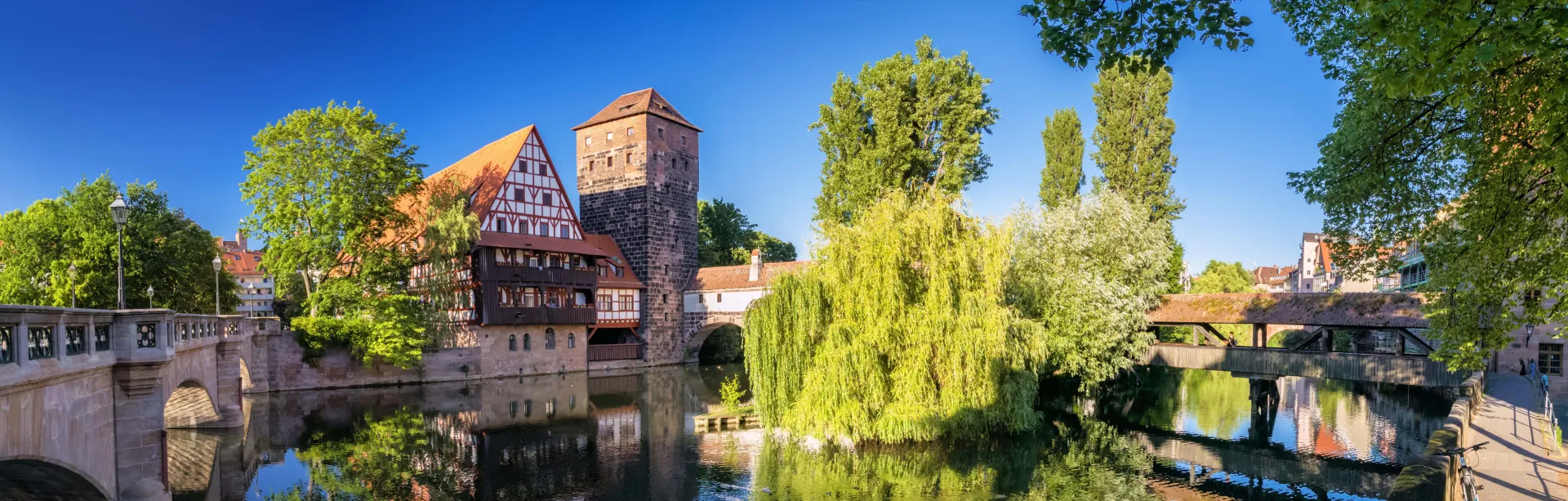
“Gott sei Dank – Ich bin a Frank” (“Thank God I’m a Franconian”) – a proud region with plenty of job potential
The Franconia region is divided between the federal states of Hesse, Thuringia, Bavaria, and Baden-Württemberg, all of which are located in the southern part of Germany. The largest part of Franconia in terms of population and area belongs to Bavaria. It has historically developed into the subregions of Middle Franconia, Upper Franconia, and Lower Franconia.
Franconia is characterized by many cultural and linguistic peculiarities, which are still proudly practiced today by some of its five million inhabitants.
The region owes its name to the Germanic tribe of the Franks, who lived in late antiquity and the early Middle Ages. Originally, the Franks settled in the Lower Rhine region and in the area that now known as the Benelux region (Belgium, the Netherlands, and Luxembourg). Later, they spread south and east. The name “Franconia” probably means “The bold/the free” (Old High German frankô = free, courageous). Most of Franconia was assigned to Bavaria during Napoleon Bonaparte’s occupation of the southern German states after the end of the Holy Roman Empire (1806).
The Franks searched for their identity for a long time, as each region had its own. However, from the beginning of the 19th century, a sense of belonging developed that still distinguishes the Franconians from Bavaria today. So it’s no surprise that the saying “Gott sei Dank, ich bin a Frank” (Thank God I’m a Franconian) still adorns many mugs and T-shirts today.
A look at the job market: well-known brands and innovative technologies
Franconia is considered one of Europe’s ten leading high-tech locations thanks to the networking of science and industry and major companies such as Siemens, Bosch, Adidas, Puma, Schaeffler, and Brose.
- The Nuremberg-Fürth-Erlangen metropolitan area offers a wide range of employment opportunities, with around 400,000 jobs and 25,000 companies.
- The labor market in Franconia is particularly well known for its industrial sector, focusing on mechanical engineering, electrical engineering, large companies, and innovative technology locations.
- Mechanical engineering is particularly well developed in Middle Franconia, which has experienced the largest increase in employment in recent years.
- Lower Franconia stands out due to its very large share of the service sector, which produces a particularly low unemployment rate.
- The Nuremberg region is an important center for transportation, logistics, communications, medicine and healthcare, energy, new materials, automation, and automotive.
- The unemployment rate throughout the state of Bavaria is only 3.9% (as of October 2025).
At ZAV, we have compiled the latest figures, data, facts, and assessments on the job market in Franconia and other promising regions for you. For detailed information, please contact our colleagues at the Customer Center.
The Federal Employment Agency of Germany
The Headquarters of the Federal Employment Agency of Germany (BA) is also located in Nuremberg (Middle Franconia). Its core tasks include job placement, labor market and career counseling, labor market observation, and labor market and career research. With approximately 113,000 employees in Germany, it is one of the largest employers. The ten regional directorates implement the BA’s strategy throughout Germany and manage the 150 employment agencies with approximately 600 branches.
One of the agencies is the International and Specialized Services (ZAV). Their employees - us - are experts regarding the international job market and the placement of specific professional groups.
Skilled professionals wanted!
As it is the case almost everywhere in Germany, the demand for skilled workers cannot be met in Franconia either. Although unemployment is rising in some sectors, there is still a significant shortage of skilled workers in many companies, especially for specialized jobs.
According to the IHK labor market radar, there is currently a shortage of some 21,000 trainees and skilled professionals in Upper Franconia. One in three companies is currently affected by this. This gap is expected to grow to a shortfall of 31,000 workers by 2028.
There are many reasons for this: social change, people moving away from rural areas, or a lack of qualifications in areas where demand is particularly high. Non-academic professions are particularly affected, especially in skilled trades, nursing, technical professions, sales, logistics, childcare, and social work.
An important solution lies in facilitating the immigration of skilled workers and their integration. The International and Specialized Services (ZAV) provides support alongside many other advisory centers.
A place for education and science
The region is home to several well-known universities, such as Friedrich-Alexander University Erlangen-Nuremberg. It offers about 300 study programs, in which approximately 40,000 students are currently enrolled. Nanotechnology, for example, is one of the most future-oriented subjects.
Julius Maximilian University of Würzburg was founded in 1402, making it one of Germany’s oldest universities. With its Center of Polymer for Life, it is a pioneer in interdisciplinary research. This field combines disciplines such as materials science, biology, physics, chemistry, engineering, and medicine.
Liquid record: Germany’s highest density of breweries
Franconia, especially Upper Franconia, has more breweries per capita than any other region in the world. There is one brewery for every 5,000 inhabitants here. There are about 250 breweries in total, many of which are small, family-run, village breweries.
Special varieties such as Rauchbier (smoked beer) are also produced there. The distinctive, smoky flavor comes from malt dried over beech wood. Schlenkerla Rauchbier from Bamberg is particularly well known. “It tastes like bacon in liquid form,” some people say.
By the way: in many places, the “Beer cellar” is not underground, but is a shady garden on a beer storage hill. While the beer is stored underground, there are outdoor bars above ground – practical, isn’t it?
At the end of the beer cellar season in late September/early October, the traditional bock beer tapping season begins in Upper Franconia. The special feature of this type of beer lies in its original wort (the proportion of dissolved substances such as sugar and minerals), its higher alcohol content of over six percent, and the fact that it is only available for a few weeks a year. This season is celebrated with a bock beer festival – and has been since the 15th century.
Classical music, rustic folk festivals, and mythical traditions
The Bayreuth Festival, also known as the Richard Wagner Festival, is a music theater festival dedicated to the last ten operas of Richard Wagner (1813 – 1883). The festival has been held intermittently since 1876 and annually since 1951 at the Festspielhaus on the Green Hill in Bayreuth. The festival usually lasts from July 25 to August 28.
A tradition that is particularly well established in Bavaria is the Kirchweih, or church consecration festival, at which the consecration of a church is officially celebrated each year. This religious ceremony is usually held on the third Sunday in October. Another integral part of the festivities is the erection of a decorated church fair tree and the so-called “Dancing out of the church fair tree.”
The Raunächte are a series of nights around the turn of the year that are considered particularly significant in European customs, including in Franconia. Normally, this refers to the twelve days between Christmas (December 24/25) and January 5.
So, if you are looking for a new place to call home, Franconia offers a home that skillfully combines tradition and modernity.
Interested in more? Further information can be found for example on the website of "Vacationing in Franconia"